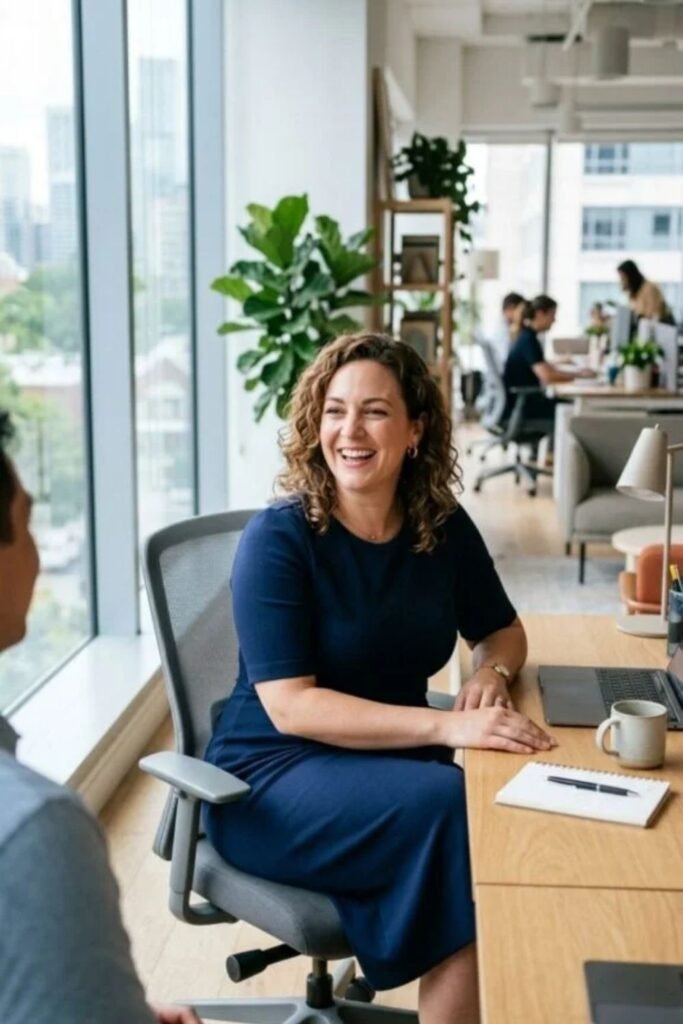
Most work clothes are cut for a body that has a straight line from ribs to hips. If your waist is smaller than your bust and your hips, nothing off the rack fits all three at once. You buy for the widest part, and the rest of the outfit swims.
So the trousers gape at the back. The blazer strains across the chest but hangs loose at the sides. The shirt buttons pull into little diagonal lines by 10am. None of that is a body problem. It is a pattern problem, and the fix is knowing which cuts, fabrics, and small alterations solve it.
The work outfits for curvy women that actually work are built on three things. Fabric with structure and a little give. Cuts that sit above or below the softest part instead of across it. And a tailor who costs less than one more failed purchase.
Here are thirteen that hold up through a full day at a desk.
1. The Wrap Dress Works, But Only If You Fix The Gap At The Chest First
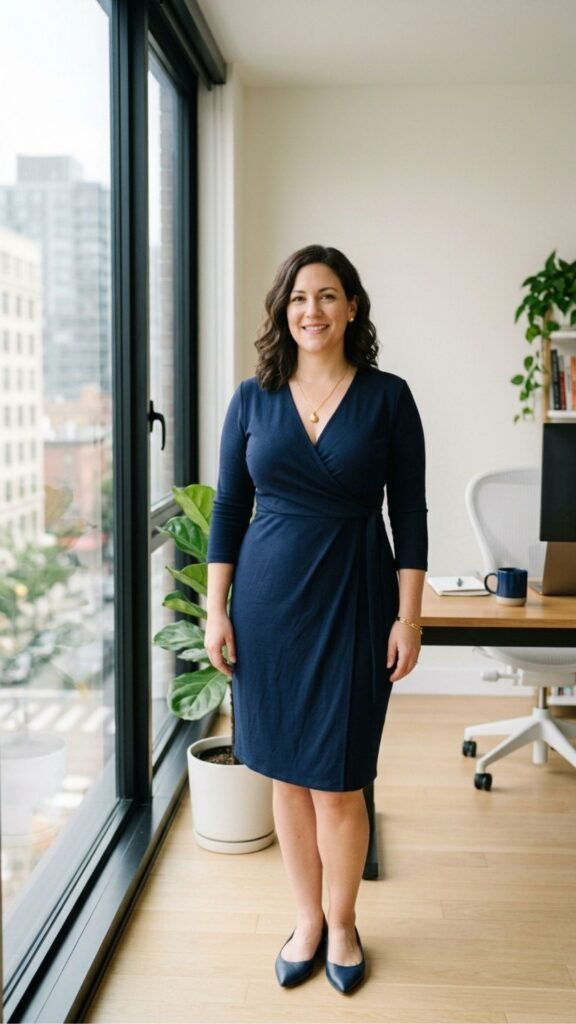
Every wrap dress has the same flaw and every brand pretends it does not.
The V opens as you move. You spend the meeting quietly pulling it closed. The dress itself is right for a curvy frame, because the tie sits at your smallest point and the skirt skims the hips instead of gripping them. The neckline is the only thing letting it down.
Two fixes, both permanent. A camisole underneath solves it in ten seconds. A single stitch or a small snap at the crossover point solves it forever.
Once that gap is closed, this becomes the easiest thing in the wardrobe.
💡 Quick Tip
Put the dress on, cross it the way you want it to sit, then mark the exact point where the two layers overlap at the chest with a pin. Sew a small snap fastener there, or hand stitch the two layers together at that single spot. It takes five minutes and the dress stays closed for good.
Also read: 11 Airport Outfit Ideas Aesthetic, Chic and Comfy for Flights
2. Buy The Blazer For Your Bust And Get The Waist Taken In
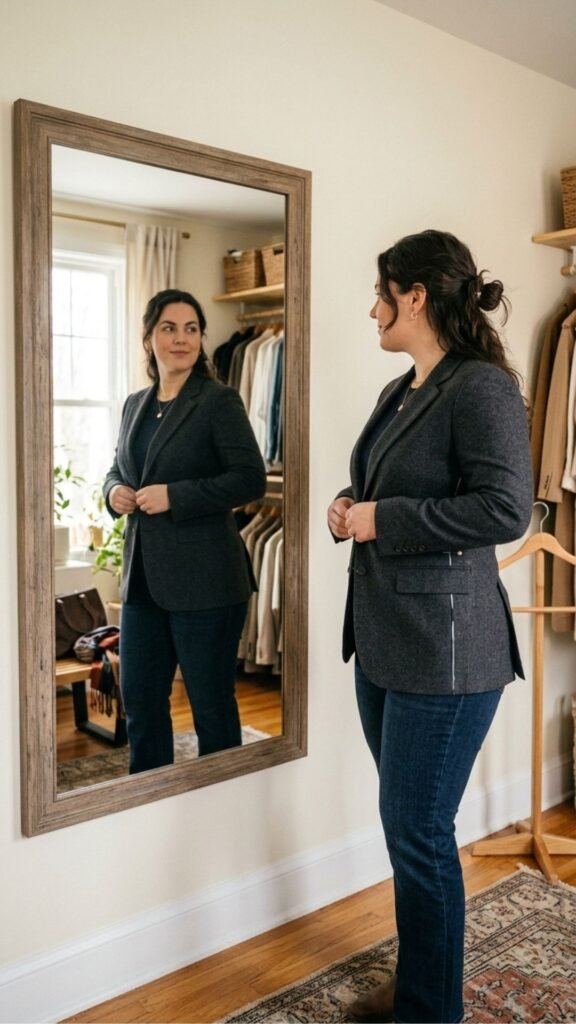
Here is the mistake almost everyone makes with a jacket.
They size down to get a waist, and then the jacket will not close, the shoulder seam sits halfway down the arm, and the lapels pull. The shoulder and the bust are the two things a tailor cannot easily fix. The waist is the one thing they can fix cheaply and quickly.
So buy the size that fits across your chest and lets your arms move. Ignore how boxy it looks in the mirror. Then take it to a tailor and ask them to nip the side seams in at the waist.
The cost is usually less than a takeaway lunch for two.
Fits the bust, hangs straight from there down. Reads as borrowed from someone larger. You keep it open because closing it makes it worse.
Same jacket, side seams brought in at the waist. Now it curves where you curve. You can button it, and the shape holds all day.
3. High Rise Trousers That Sit Above The Softest Part, Not Across It
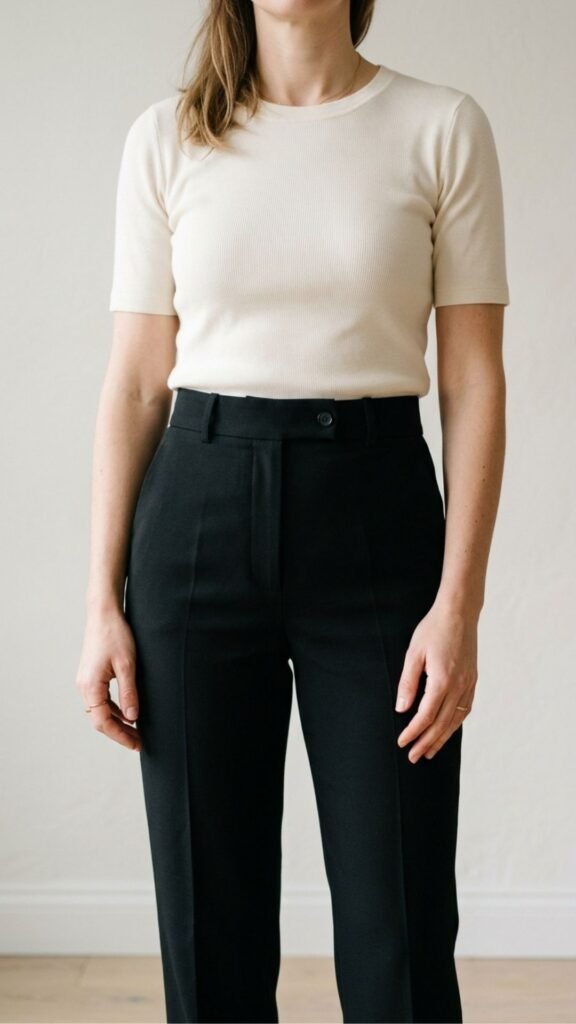
Waistband placement decides how comfortable you are at 4pm.
A mid rise trouser lands right across the softest part of the stomach, so it digs in when you sit and creates a line under a fitted top. A true high rise sits above it, at the narrowest point of your torso, and stays there. Nothing rolls down. Nothing presses in. The trouser also gets to skim your hips rather than cut into them.
Check the rise measurement in the product details rather than trusting the word “high.” Anything under about 11 inches at the front is not really high rise on most curvy frames.
| True high rise | Mid rise |
|---|---|
| Sits above the soft part, at the narrowest point | Lands right across the soft part and presses in |
| Stays put when you sit down for hours | Rolls or folds over by the afternoon |
| Gives you a clean line to tuck a shirt into | Creates a visible ridge under fitted tops |
| Makes the leg look longer from the waist down | Cuts the torso in the middle |
4. Ponte Knit Is The Fabric That Holds You In Without Squeezing
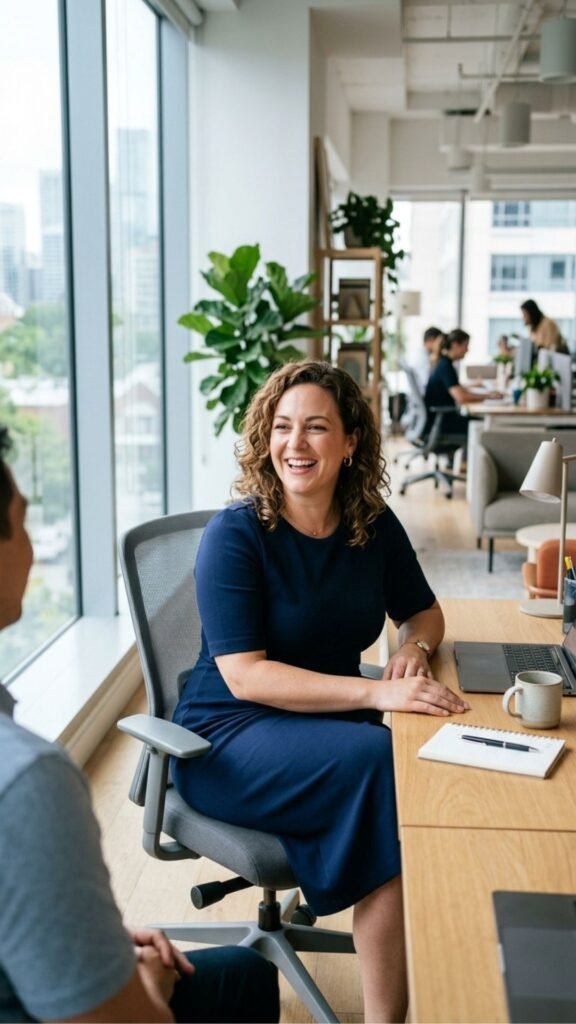
Fabric does more for fit than size ever will.
Thin polyester clings to every line and shows every seam of what is underneath. Stiff woven cotton has no give, so it pulls at the hips and gapes at the waist. Ponte knit sits between the two. It has weight, it holds a shape, it stretches when you sit and springs back when you stand, and it does not crease across the lap after a morning at a desk.
Scuba crepe and heavy jersey do a similar job. All three feel like comfortable clothes and look like structured ones.
If you only change one thing this year, change the fabric before you change the size.
5. Why A V Neck Beats A Crew Neck On A Full Bust Every Single Time
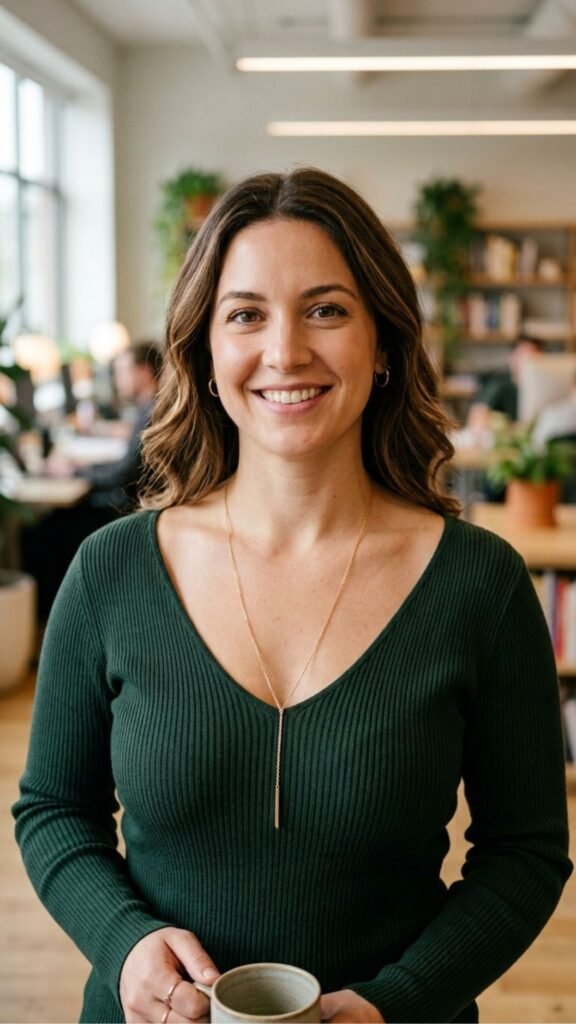
A crew neck on a full bust creates one wide, solid block from the shoulders down.
There is no break in it, nothing for the eye to follow, and the fabric has to stretch across the widest point without any room to go anywhere. A V neck opens that block up. It gives the top half a vertical line, it lets the collarbone show, and it stops the shirt from pulling into horizontal creases across the chest.
Scoop necks and open collars do the same job with a softer edge. Depth matters more than shape, so pick whichever sits comfortably at work.
Turtlenecks are the exception, and only in a fine knit worn under a blazer.
Necklines that open up the top half
6. Stop Belting At Your Natural Waist If Your Hips Do The Talking
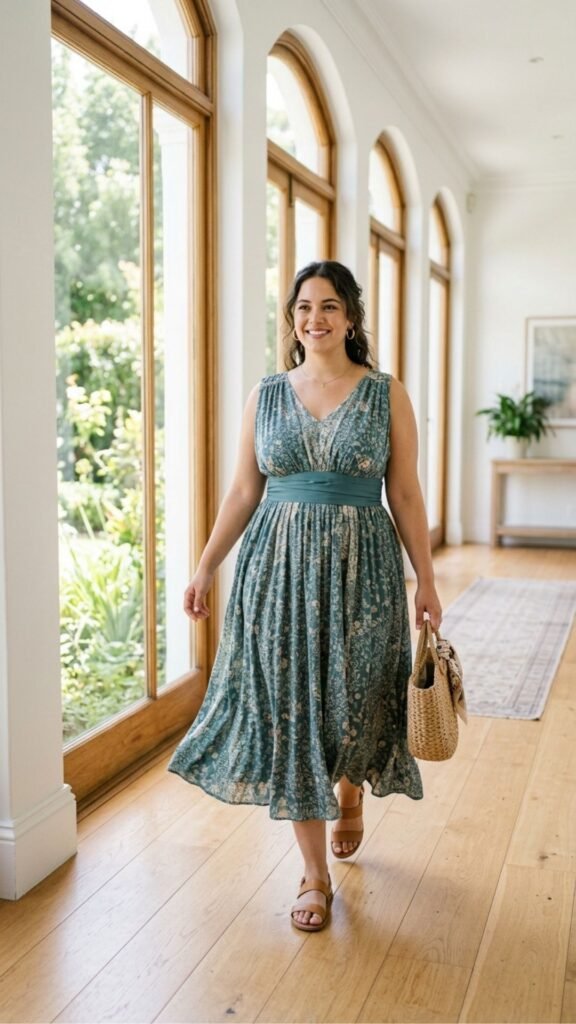
A belt at the natural waist is standard advice, and for some bodies it backfires.
If your hips are the widest part of you, a belt cinched at the smallest point directly above them creates a sharp contrast. The eye goes straight to the widest line. Move the belt higher, closer to the underbust, and the contrast softens. The line lands where your body is narrower and the fabric falls loose from there down.
Width matters too. A wide belt sits across more of the torso and stays put. A thin one rides up and gets buried in fabric by lunchtime.
Try it in the mirror once and you will see the difference immediately.
Sit the belt higher, just under the bust, and let everything below it fall free.
Choose a wider belt so it holds its position and does not fold in on itself.
Match the belt to the outfit colour so it reads as a seam, not a stripe.
A thin belt cinched tight right above the hip, which draws a line at the widest point.
A belt in a loud contrast colour, which cuts the outfit clean in half.
Belting a cardigan that already has bulk. The fabric bunches and nothing sits flat.
7. The Half Tuck Rule That Defines Your Waist Without A Tight Shirt
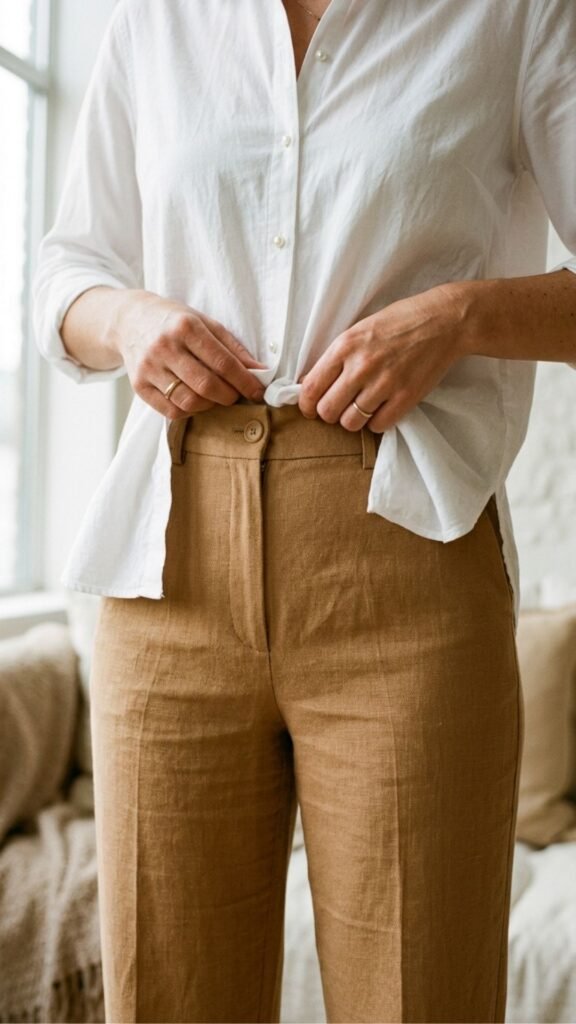
Fully tucking a shirt means the shirt has to be tight, and a tight shirt on a full bust pulls.
The half tuck skips that problem. You tuck a small section at the front, near the button of the trousers, and leave the rest loose. That single tuck shows where your waist is. Everything else drapes over the hips instead of hugging them. The shirt can be a size bigger than you would normally wear and it still looks intentional.
It works best with a high rise trouser, because there is somewhere for the tuck to sit.
Keep the tuck small. A fistful of fabric, not half the shirt.
Put on a high rise trouser or skirt. The tuck needs a high waistband to sit against.
Take a small handful of the shirt front, just off centre, near the button.
Push it down behind the waistband, then let go. Do not smooth it flat.
Leave the sides and back hanging loose. The unevenness is the whole point.
8. Pencil Skirts Need A Vent And A Lining, Or They Ride Up All Day
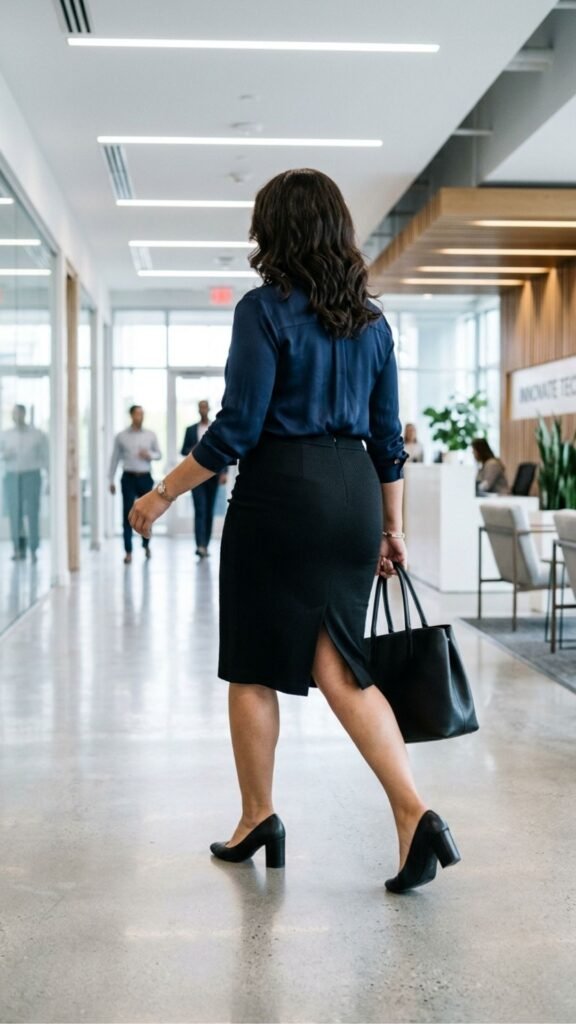
The pencil skirt gets blamed for a problem it does not have.
It is not the shape that fails, it is the build. A skirt with no vent has nowhere to give when you walk, so it creeps upward with every step. A skirt with no lining sticks to tights and rides up the same way. Add both, and the skirt stays where you put it.
Look for a back vent of at least four inches and a full lining before you look at anything else. A stretch woven with a little elastane helps too.
If a skirt you already own is riding up, a tailor can add a lining. It is cheaper than replacing it.
9. One Colour Head To Toe Reads Long, Even When Nothing Is Fitted
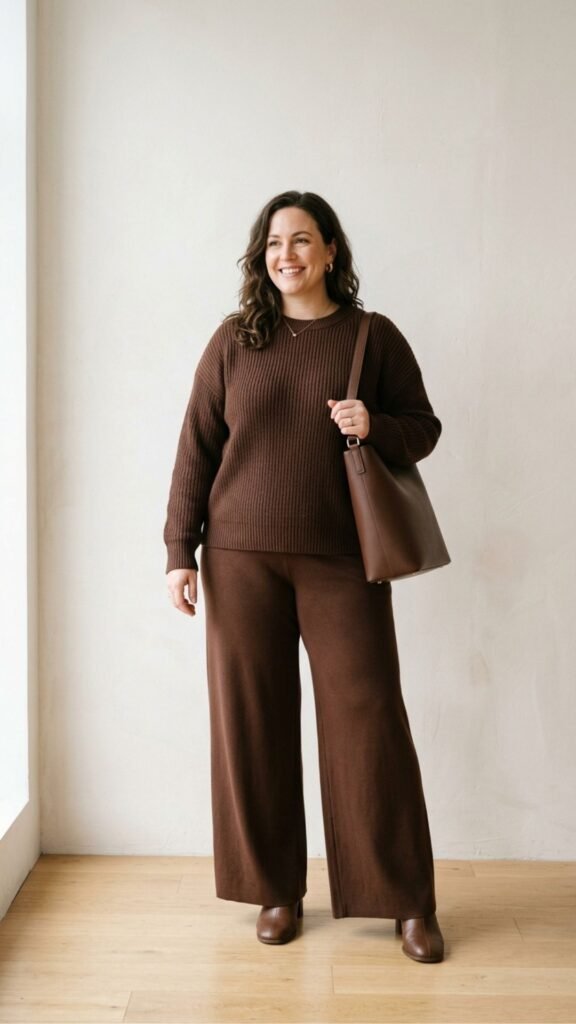
Two colours split you in half. One colour does not.
When the top and the bottom are the same shade, there is no line across the middle and no place for the eye to stop. It reads as one long vertical piece. This is the reason a navy trouser with a navy knit looks sharper than the same trouser with a cream one, even though neither is fitted. It also means you can wear looser, more comfortable cuts without them looking shapeless.
It does not have to be black. Charcoal, navy, chocolate, and deep olive all do the same job at work.
If an outfit feels off and you cannot say why, put the top and the bottom in the same colour. It fixes more than tailoring does.
10. The Shoe Choice That Makes Wide Leg Trousers Work On Shorter Legs
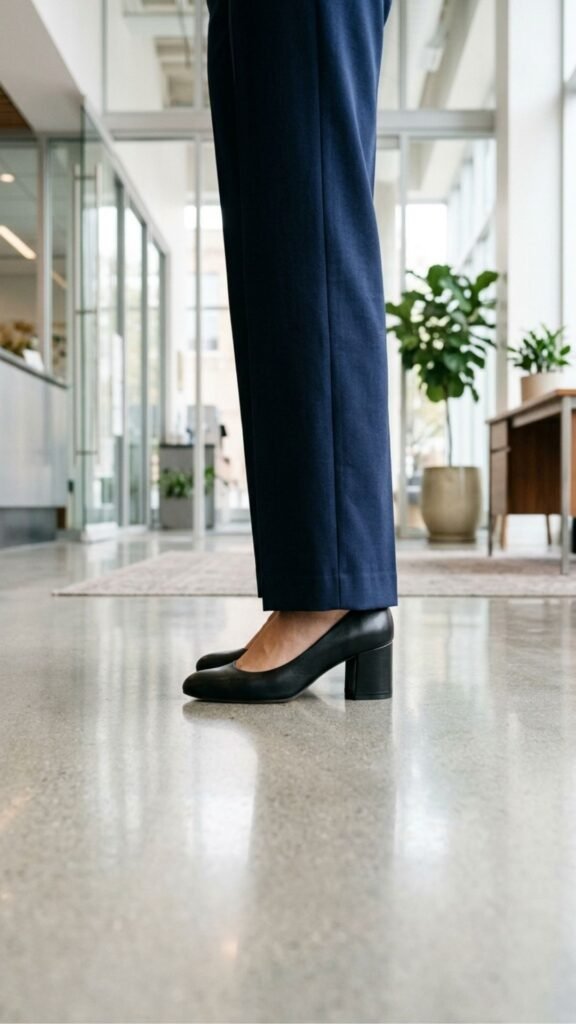
Wide leg trousers are comfortable and forgiving, and they swallow you whole if the shoe is wrong.
The volume in the leg needs height underneath it, otherwise the hem drags and the whole line collapses at the floor. A block heel gives you that height and stays stable on a hard office floor all day. A pointed flat works too, because the point adds visual length even without a heel. A round toe flat gives you neither.
Hem length is the other half of it. The trouser should just clear the floor when you wear the shoe you plan to wear with it.
Get them hemmed for one pair of shoes. Not two.
| Shoe | What it does under a wide leg |
|---|---|
| Block heel | Adds real height, holds the hem off the floor, comfortable for a full day standing |
| Pointed flat | No height, but the point extends the line so the leg still reads long |
| Round toe flat | Hem sits on the floor, foot disappears, the whole outfit stops short |
| Chunky trainer | Adds bulk at the widest point of the trouser. Fine on casual days, not client days |
11. Sleeve Length Matters More Than Sleeve Style On A Fuller Arm
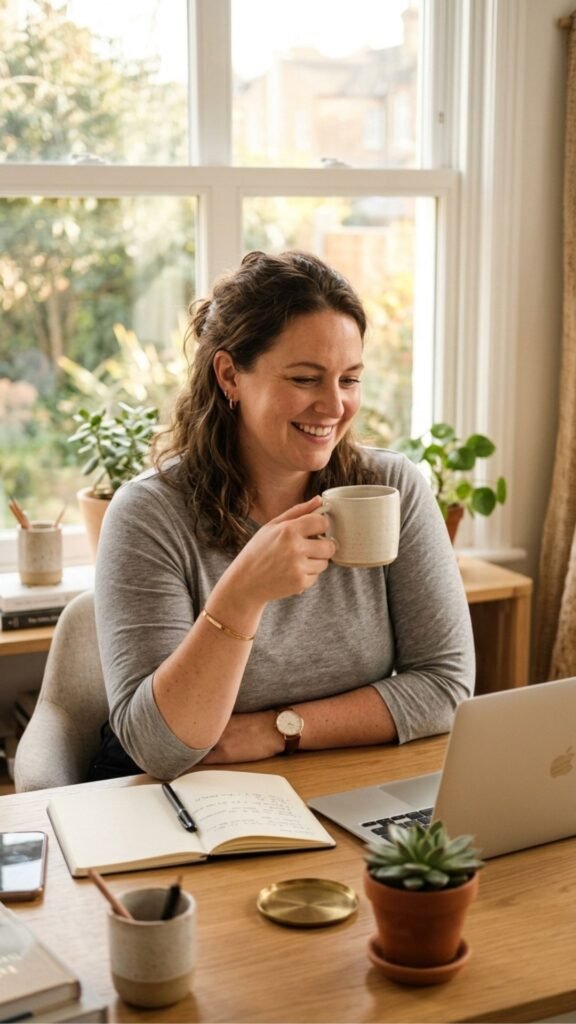
People fuss over sleeve style and ignore the thing that actually changes the look.
Where the sleeve ends decides how the arm reads. A cap sleeve stops at the widest part of the upper arm and draws a hard line right there. A short sleeve that ends just above the elbow clears it. A three quarter sleeve is the reliable one, because it ends at the narrowest part of the forearm and shows the wrist, which is small on almost everyone.
Fabric matters as a second thought. Something with drape falls away from the arm. Something stiff sits against it.
Full length sleeves work too, just push them up.
📌 Good To Know
The three quarter sleeve rule: any sleeve that ends between the elbow and the wrist will work. The forearm is narrower than the upper arm on nearly every body, so ending the sleeve there gives you a slim point and a visible wrist. If a top has full sleeves, push them up to the same place and you get the same effect for free.
12. Build A Five Piece Work Capsule So You Stop Panicking On Monday
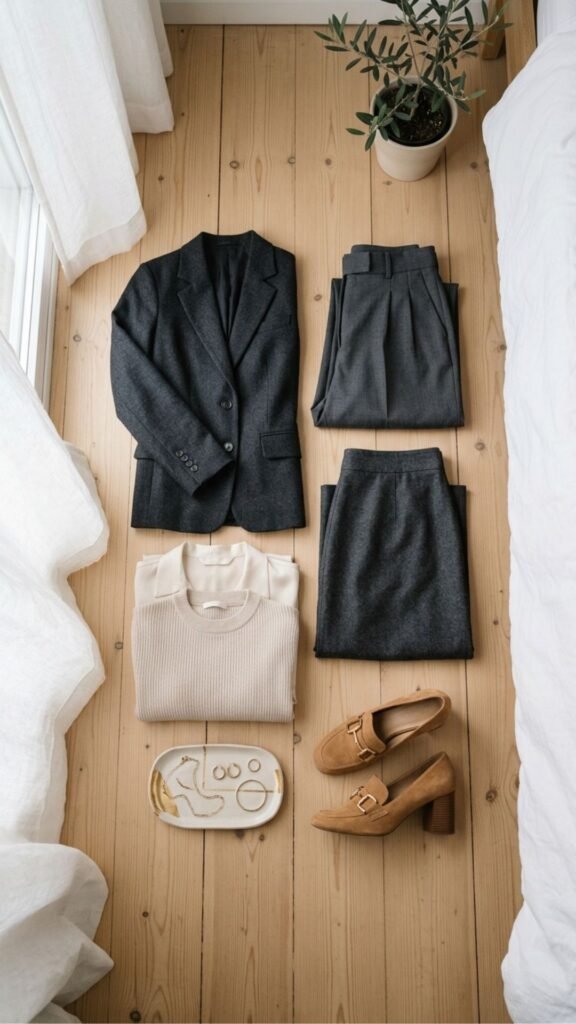
Monday morning is not the time to be making decisions.
A small set of pieces that all work together removes the decision entirely. You need one blazer that fits your bust, one pair of high rise trousers hemmed for your usual shoe, one pencil or A line skirt, two or three tops in the same colour family, and one pair of shoes you can wear all day without thinking. That is it. Every piece goes with every other piece.
The point is not to own less. It is to own five things that are right, so getting dressed takes two minutes instead of twenty.
Add to it slowly, and only when something earns its place.
13. Find A Tailor Before You Find Another Brand
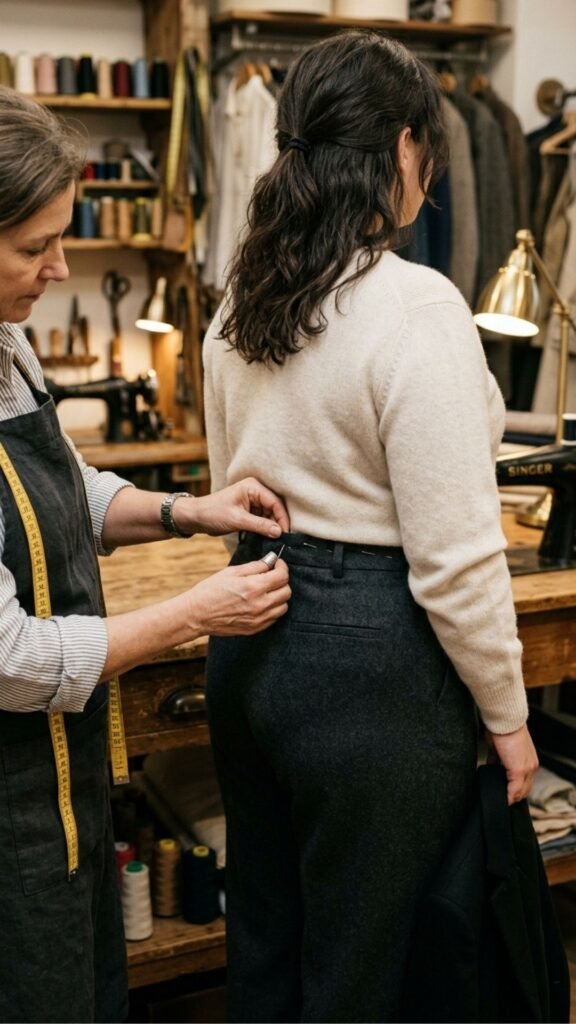
The next brand will not fix this. A tailor will.
Nothing mass produced is cut for a body with a real difference between bust, waist, and hips, because grading a pattern for that is expensive and most brands skip it. You can keep hunting for the label that finally gets it right, or you can buy the size that fits your widest measurement and pay someone forty minutes of their time to bring in the rest.
Start small. Take one pair of trousers and ask for the back waist to be taken in. See what it costs and how it feels.
That single alteration usually changes how someone shops forever.
Trousers that fit the hips and gape at the back waist. You wear a belt to hold them and the belt bunches the fabric. Four returns, no keeper.
Same trousers, back waist taken in an inch. They sit flat, stay up without a belt, and you stop thinking about them at all.
Getting Dressed Should Take Two Minutes
None of this is about hiding anything. It is about fabric that holds its shape, waistbands that sit where they should, and a tailor who fixes the gap between how clothes are cut and how you are built. The clothes were the problem. They always were.
Start with one change. Take a pair of trousers in at the back waist, or swap one thin polyester top for a ponte knit. See how different it feels by 4pm. The best work outfits for curvy women are the ones you forget you are wearing.
Save this list for the next time you are staring at your wardrobe on a Sunday night, already dreading Monday.
The five things to change first