

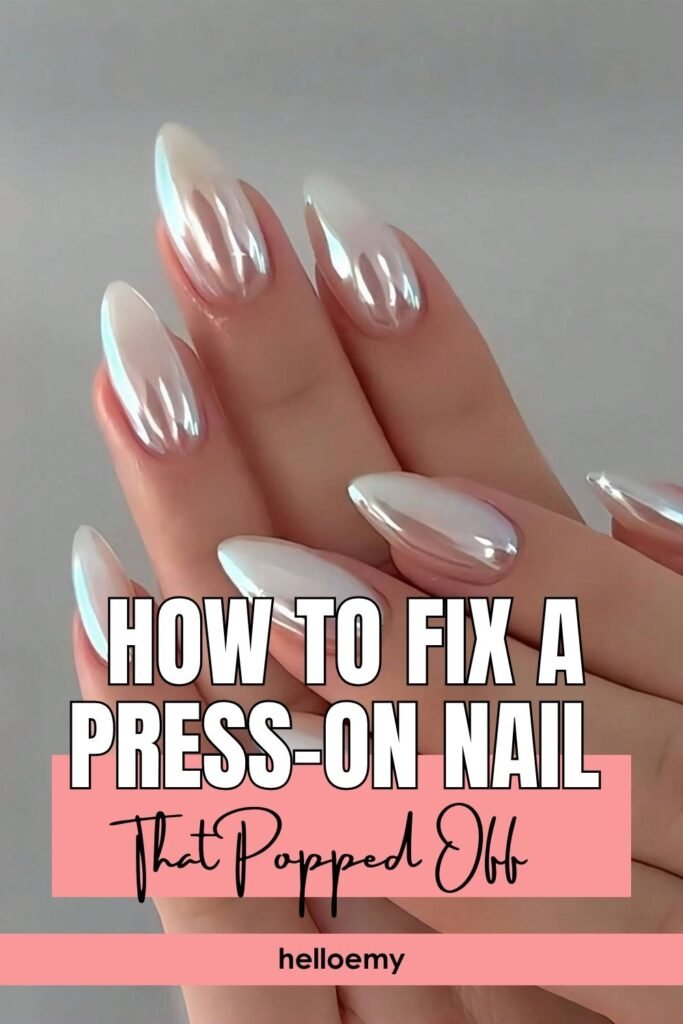
One nail is gone and the other nine still look perfect. That is the worst version of this problem, because you cannot hide it and you do not want to redo the whole set. The good news is that a press on nail repair takes about 15 minutes, and the nail that popped off is almost always still usable.
Most re-glued nails pop off again within a day, and bad glue is rarely the reason. The real problem is the layer of old dried glue left on both surfaces. Fresh glue needs to grab bare nail and bare plastic. When it lands on top of an old glue film instead, it holds for a few hours and then slides off in the shower.
So this fix is mostly cleanup. You will strip the old glue off the back of the press-on, buff it off your natural nail, wipe both down, and re-glue using pressure and patience instead of extra glue. Hands-on time is about 10 minutes. The rest is waiting while the bond sets.
Lost the nail completely? Pull the spare from your kit in the same size and the steps work exactly the same way. Get your glue, a buffer, and a paper towel on the table, and let’s fill in that gap.
Wash and dry both hands before you touch anything else
Hand lotion, sunscreen, and your own skin oil are all glue killers. Use plain soap and warm water, then dry with a paper towel rather than a cloth towel, which leaves lint on your fingertips. Skip moisturizer afterward, even on the hand that feels tight. You can put it back on once the nail is set.
Inspect the nail for cracks before you start the press on nail repair
Hold it up to a window and look at the tip first, because that is where hairline cracks hide. Four things tell you the nail is worth reusing:
- The tip has no split running through it
- The curve still matches the shape of your nail bed
- The underside is not warped or flattened out
- No chunk is missing from the free edge
A cracked nail will pop off again within a day no matter how carefully you glue it. Reach for a spare in the same size instead.
Peel the old glue off the back of the press-on
Flip the nail over and you will see a cloudy film where the old glue dried. Catch one edge of that film with your thumbnail or your tweezers, then lift it away in one sheet. It usually comes off whole. If it fights you, soak the nail in warm water for 2 minutes and try again once the film softens.
Do not pull the glue off with your teeth or scrape it with a metal file. Teeth crack thin press-ons at the stress point, and metal gouges the plastic, which leaves the nail sitting unevenly forever. Soak longer if you have to, but keep it under 5 minutes so the nail does not soften and lose its curve.
Buff the leftover glue off your natural nail
Your nail plate has a matching film on it, and it is easier to miss because it is clear. Run the buffer over the whole nail in light strokes until the shine is gone and the surface looks evenly matte. Three or four passes is plenty. Push any cuticle skin back with the wooden stick first so you can reach the base, where lifting always starts.
Press very lightly and stop as soon as the shine disappears. Buffing past that point thins your natural nail and makes the next few weeks painful. No buffer in the house? A clean emery board used on its softest side works, or the rough strip on the back of a matchbox in a pinch.
Wipe the nail plate with rubbing alcohol
Buffing leaves dust behind, and dust sits between your nail and the glue like a layer of sand. Soak a cotton pad, wipe the nail from base to tip, and give it 20 seconds to dry completely. The surface should look chalky, not wet. Wipe the underside of the press-on the same way while you are at it.
Test the fit before you open the glue
Set the dry nail on your finger and look at it from the side. The base should sit flush against your cuticle line with no daylight underneath, and the sides should not ride up over your skin. Nails that popped off after a week often no longer fit, because your natural nail grew and the curve changed. If the press-on rocks or overhangs, file the sides down a hair and test again. A nail that does not fit dry will not fit better with glue under it.
Apply a thin layer of glue to both surfaces
Two small drops do the whole job. Put one on your natural nail and spread it toward the tip with the nozzle, then put one on the back of the press-on and spread that toward the base. Gluing both sides sounds like overkill, but it stops dry patches from forming where the two curves do not quite meet. Keep every drop inside the nail line.
More glue does not mean a stronger hold. It means glue squeezing out onto your cuticle, hardening into a ridge, and lifting the whole nail off in three days. If glue does land on your skin, leave it alone until the nail is set, then roll it off with warm water and a wooden stick. Never peel skin that is stuck to a nail.
Press the nail down at an angle and hold for 30 seconds
Line the base up against your cuticle first, tilted at about a 45 degree angle, then lower the tip down slowly. Coming in flat traps air under the middle. Once it is down, press firmly with your thumb and count to 30. Rock your thumb from the base to the tip while you hold so the pressure reaches the edges too.
Hold the pressure steady rather than pumping your thumb up and down. Every time you lift, the glue starts to set in that position and a tiny gap opens. Steady pressure for the full 30 seconds is what makes the difference between a nail that lasts two days and one that lasts two weeks.
Check the edges for gaps and lifting
Look at the nail from the side and from underneath the tip. You want a solid line where the plastic meets your skin, with no white gaps and no bubbles floating in the middle. Press down again on any spot that looks lifted, holding it for another 15 seconds. Bubbles caught now can still be pushed out toward the tip. Once the glue cures, they stay.
Wait 10 minutes before water, lotion, or hairspray
The nail feels solid after 30 seconds, and that is the trap. Nail glue keeps hardening underneath for several more minutes, and warm water during that window softens the bond right back down. Give it 10 minutes of nothing at all. No dishes, no shower, no hand cream, no picking at the edges to test it.
Fill the time with something that keeps your hands still. Then wash normally and treat the nail like any other one in the set.
Press On Nail Repair FAQ
A few questions come up again and again once people start fixing their own nails at home. Here are the short answers.
Can I reuse a press-on nail that popped off?
Yes, as long as the tip has no cracks and the curve still matches your nail bed. Strip the old glue from the back first, or it will pop off again within a day.
Can I use super glue instead of nail glue?
It holds, but it is not made for skin and it dries brittle, so the nail tends to crack off and take a layer of your natural nail with it. Keep a spare tube of nail glue in your bag instead.
Why do my press-ons keep popping off the same finger?
That finger usually does the most work, like your thumb or index finger. Buff a little longer at the base, use slightly more pressure when you press down, and keep that hand out of hot water for the first hour.
How long should the repaired nail last?
Around one to two weeks if the surfaces were properly cleaned. A rushed fix with old glue left on typically gives you two or three days.
Do I need to file the nail after gluing it back on?
Only if the shape no longer matches its neighbors. Wait until the glue has fully set, then file the free edge with light strokes in one direction.
Is it bad for my natural nails to keep re-gluing?
The gluing itself is fine. The damage comes from peeling nails off dry, so always soak in warm water before removal and buff gently rather than hard.
Nail glue, buffer, rubbing alcohol, cotton pad, wooden cuticle stick, tweezers, nail file, paper towel, small dish of warm water.
- Wash and dry both hands, no lotion
- Check the nail for cracks and warping
- Peel the old glue film off the back
- Buff your natural nail until matte
- Wipe with alcohol, dry 20 seconds
- Dry-fit the nail before opening glue
- Two thin drops, one on each surface
- Set base first at 45 degrees, hold 30 seconds
- Press out gaps and bubbles at the edges
- Wait 10 minutes before water or lotion
Clean surfaces matter more than strong glue. Total time 15 minutes.
You Did It
Your set is whole again, and you spent 15 minutes instead of an hour redoing all ten nails.
Keep a small pouch in your bag with glue, a mini buffer, and one spare nail in each size. The next press on nail repair happens wherever you are, in about the same time it takes to wait for coffee.
Save this pin so the steps are in your phone the moment a nail pops off, and follow along for more nail fixes you can do at home.
